I started this blog 11 years ago, at the beginning of 2009, as a study abroad journal. It's joined me around the world, on vacations, during undergrad and graduate work, through relationships and job changes, and in quieter moments of life. It's been confidant, scrapbook, therapist, homework, and experiment. It's seen seasons of prolific writing, creative droughts, and steady routines.
Altogether, it's been good. I've hopefully convinced others to read something new, try out a recipe, or take on a fun challenge. I've definitely seen myself grow and change, and explored who I am and what's important to me. I'm convinced this blog helped me get hired more than once.
After reflecting on all of this and looking forward to what's to come in 2020, it's time to say goodbye (for now).
Of course, the biggest thing coming for me, personally, is parenthood times 2 - and all that comes with becoming a family of 4 instead of a couple. I'm ready for my "babies" to be my human babies and for this "baby" to take a break. Professionally, I'm still fresh in my field and have lots to learn and think about. These things feel more like beginnings than endings, so I'll say this break is the beginning of something else, not the end of this blog.
I won't say I'll never post again, but I won't worry about posting or keeping any sort of schedule either. I feel grateful for the decade+ to work and play here, and the end of this decade feels like the right time to peace out for a bit.
Wishing everyone a safe, warm, happy, and fulfilling 2020 & beyond.
Showing posts with label process. Show all posts
Showing posts with label process. Show all posts
Wednesday, January 1, 2020


Wednesday, August 22, 2018
Instructional Project Reflection
For our final project, my group decided to do a live database tutorial that would assist a fictional 8th grade class in their research for a fictional biographic research project. This activity would also assist the fictional teacher who assigned the project, as their students would be better prepared to complete the assignment. Choosing a topic for our lesson was fairly easy: we knew we wanted to teach middle school students and we also wanted to teach a database, so we browsed Dominican's offerings to see what would be age-appropriate and what could be linked with an actual classroom assignment (as opposed to doing a database walk-through just because). Britannica Online has a very user friendly interface that can be used by students young and old, and we liked the extensive biographies it has, so we went with that.
Creating the lesson once we had an end assignment and a few potential standards/outcomes took some trial and error, but on the whole was very productive. We tossed around ideas for database scavenger hunts, worksheets, and team competitions to find certain information. We all wanted to make the tutorial fun, interactive, and not too stressful - using the database isn't the assignment our fictional students are getting graded on, so our goal was more focused on getting them comfortable with the different features and with composing appropriate research questions than in quizzing them on the database itself.
The easiest way to engage learners is to get them doing something. Make it interactive, make the student the expert, and keep the stakes low. Our scavenger hunt starts with easier questions that get more challenging as the students explore, but there is no wrong way to find the answers. The important part is that the students try, and that they observe how their classmates found the information. If two students find the same information in two different ways, they are both right! I'm hoping the "challenge" factor engages our learners and increases their comfort with the database.
Creating the lesson once we had an end assignment and a few potential standards/outcomes took some trial and error, but on the whole was very productive. We tossed around ideas for database scavenger hunts, worksheets, and team competitions to find certain information. We all wanted to make the tutorial fun, interactive, and not too stressful - using the database isn't the assignment our fictional students are getting graded on, so our goal was more focused on getting them comfortable with the different features and with composing appropriate research questions than in quizzing them on the database itself.
The easiest way to engage learners is to get them doing something. Make it interactive, make the student the expert, and keep the stakes low. Our scavenger hunt starts with easier questions that get more challenging as the students explore, but there is no wrong way to find the answers. The important part is that the students try, and that they observe how their classmates found the information. If two students find the same information in two different ways, they are both right! I'm hoping the "challenge" factor engages our learners and increases their comfort with the database.
Monday, August 20, 2018
Pathfinder Reflection
After thoroughly enjoying the curation assignment, I was interested in preparing a more focused pathfinder. Honestly, curating themed resources is something I do fairly naturally, but intentionally sitting down to do it still had its challenges. First, I needed a topic. I love and crave limits and the creativity they foster, so on the one hand, I was excited to narrow down my resource gathering, but on the other hand I was overwhelmed by my options of topics! And of course, after all my practice in creating lesson plans and working with classroom teachers to create co-curricular assignments, I couldn't think of ANYTHING I wanted to do.
I started a few different pathfinders to see which topic's potential resources felt best, and to see which curation tool I wanted to use. I looked at the LIS 724 website, saw a few tools that I hadn't used before, tried Scoop.It, hated it, and went back to Wakelet. It's just so streamlined. Pearltrees would have also worked, but I liked being able to add more text to explain my resources. I started gathering mermaid resources, fairytale retelling resources, and Chicago resources, and found that I was most interested in collecting a more specific set of Chicago history resources - primary sources and artifacts. That led me to gathering websites, books, encyclopedias, and archives related to Chicago's history in general and four events in particular: Fort Dearborn, the Great Chicago Fire of 1871, the World's Columbian Exposition of 1893, and the Century of Progress Exposition of 1933-34. Chicagoans and other discerning historians will recognize these events as the ones represented by the four stars on Chicago's flag, which for me was the easiest way to narrow down the expanse of Chicago history.
 I know I'll be using pathfinders throughout my career and in my personal life (my booklists here are a sort of pathfinder) for years to come, so it's helpful to try out new platforms and topics that students or curious Chicagoans may actually find useful!
I started a few different pathfinders to see which topic's potential resources felt best, and to see which curation tool I wanted to use. I looked at the LIS 724 website, saw a few tools that I hadn't used before, tried Scoop.It, hated it, and went back to Wakelet. It's just so streamlined. Pearltrees would have also worked, but I liked being able to add more text to explain my resources. I started gathering mermaid resources, fairytale retelling resources, and Chicago resources, and found that I was most interested in collecting a more specific set of Chicago history resources - primary sources and artifacts. That led me to gathering websites, books, encyclopedias, and archives related to Chicago's history in general and four events in particular: Fort Dearborn, the Great Chicago Fire of 1871, the World's Columbian Exposition of 1893, and the Century of Progress Exposition of 1933-34. Chicagoans and other discerning historians will recognize these events as the ones represented by the four stars on Chicago's flag, which for me was the easiest way to narrow down the expanse of Chicago history.
Monday, August 13, 2018
Database Tutorial Reflection
Before starting this assignment, I was not looking forward to screencasting and recording because, like most human people, I do not like hearing my own voice played back at me. Having to use voice overs in our Digital Storytelling assignment helped get me more comfortable with it, and once I had a basic script and went through my database routine a few times, I was ready to try it out.
I used Screencastify because it has such an easy interface for my Chromebook, and videos are saved automatically to my Google Drive. I found the process super quick and easy, and did a practice run of my tutorial. Take 1 helped me decide what was useful and better ways to click through the pages and options of my chosen database (JSTOR), and with a few notes to myself about enunciation, I was ready for Take 2. An almost immediate word flub sent me to Take 3, which gave me a pretty solid final product.

So solid, in fact, that I thought to myself, "I bet I could improve a few more things and streamline the process." BIG MISTAKE. The number one thing I have (re)learned with this assignment: a good and done job is better than great or perfect and not done. I should have been happy with Take 3 and its minor word stumble because Takes 4-7 all had technical difficulties (my laptop took extra time loading pages, the sound cut out at one point, and I could not get the Screencastify extension to stop recording, leading to 30 extra seconds of silence at the end of one video).
After a short break and a few deep breaths, I was ready to try again and take whatever okay product I could get. Luckily, Take 8 was the charm and here I have a Final Product.
From now on, I'll be extra forgiving of online tutorials with minor mistakes or flubs (including my own) - probably the creator of those just wants the product done and out there to help others, and has gone through multiple takes of even worse videos or just okay videos that they wanted to improve. As a lapsed perfectionist, I understand that done is better than perfect, but it's always a good to be reminded of that in practice!
I used Screencastify because it has such an easy interface for my Chromebook, and videos are saved automatically to my Google Drive. I found the process super quick and easy, and did a practice run of my tutorial. Take 1 helped me decide what was useful and better ways to click through the pages and options of my chosen database (JSTOR), and with a few notes to myself about enunciation, I was ready for Take 2. An almost immediate word flub sent me to Take 3, which gave me a pretty solid final product.

So solid, in fact, that I thought to myself, "I bet I could improve a few more things and streamline the process." BIG MISTAKE. The number one thing I have (re)learned with this assignment: a good and done job is better than great or perfect and not done. I should have been happy with Take 3 and its minor word stumble because Takes 4-7 all had technical difficulties (my laptop took extra time loading pages, the sound cut out at one point, and I could not get the Screencastify extension to stop recording, leading to 30 extra seconds of silence at the end of one video).
After a short break and a few deep breaths, I was ready to try again and take whatever okay product I could get. Luckily, Take 8 was the charm and here I have a Final Product.
From now on, I'll be extra forgiving of online tutorials with minor mistakes or flubs (including my own) - probably the creator of those just wants the product done and out there to help others, and has gone through multiple takes of even worse videos or just okay videos that they wanted to improve. As a lapsed perfectionist, I understand that done is better than perfect, but it's always a good to be reminded of that in practice!
Wednesday, August 8, 2018
Digital Storytelling Reflection
Similarly to creating book trailers, the process of digital storytelling can be both fun and overwhelming. There are so many options and ways to tell your library's story! A person has to know their own style, or their library's style, to help narrow down editorial choices and make sure that the video is reaching the right audiences.
Speaking of audiences, something to think about when creating digital media like library tours, interactive reading lists, or other video-based content is who the content is for. What age? Parents or the students/youth themselves? And beyond that, what level of familiarity or comfort does this audience have with media - that is, what is their media literacy? Will the audience be able to access your video and understand it? Does the video have both visuals and audio? Not all tools will be useful to all library patrons, so it's helpful to use a variety of them to reach the largest audience.
Overall, using digital storytelling to create short videos was a simple process that has many uses within the library and on a library's website. I'll definitely be thinking of ways to use digital storytelling in my own librarianship!
Speaking of audiences, something to think about when creating digital media like library tours, interactive reading lists, or other video-based content is who the content is for. What age? Parents or the students/youth themselves? And beyond that, what level of familiarity or comfort does this audience have with media - that is, what is their media literacy? Will the audience be able to access your video and understand it? Does the video have both visuals and audio? Not all tools will be useful to all library patrons, so it's helpful to use a variety of them to reach the largest audience.
Overall, using digital storytelling to create short videos was a simple process that has many uses within the library and on a library's website. I'll definitely be thinking of ways to use digital storytelling in my own librarianship!
Prezi Reflection
While I've seen Prezi presentations and heard various views on its usability and merit, this was my first time creating a Prezi. I found it fairly intuitive and easy to get started with, but the more I explored, the more there was to do and work with. Overall, Prezi seems like the type of tool that is easy to learn, but difficult to master.
The collaborative element of Prezi was very handy, as I could see live updates as my group mates worked on their sections. One of us could upload an image or type out a section of text and have the rest of us okay it or proof it for them on the spot. There weren't any issues of saving progress and sending updated files, or worrying about others' contributions.
As an option for presenting alongside Google Slides, Prezi does offer some cool elements - the movement of "slide" to "slide" being its most distinctive. I like that with Prezi, a presenter can jump around from topic to topic depending on where their presentation is going (hopping back a topic to answer a question, or skipping a topic that may not need to be covered, for example) without skipping through each individual slide. That same feature is one of Prezi's downfalls as well, as all the jumping and hopping may leave audience members a bit woozy. I think that Google Slides will always be my go-to out of comfort and ease of use, but I'll definitely keep Prezi as a backup for times I want to present things in a more holistic versus narrative way.
The collaborative element of Prezi was very handy, as I could see live updates as my group mates worked on their sections. One of us could upload an image or type out a section of text and have the rest of us okay it or proof it for them on the spot. There weren't any issues of saving progress and sending updated files, or worrying about others' contributions.
As an option for presenting alongside Google Slides, Prezi does offer some cool elements - the movement of "slide" to "slide" being its most distinctive. I like that with Prezi, a presenter can jump around from topic to topic depending on where their presentation is going (hopping back a topic to answer a question, or skipping a topic that may not need to be covered, for example) without skipping through each individual slide. That same feature is one of Prezi's downfalls as well, as all the jumping and hopping may leave audience members a bit woozy. I think that Google Slides will always be my go-to out of comfort and ease of use, but I'll definitely keep Prezi as a backup for times I want to present things in a more holistic versus narrative way.
Monday, August 6, 2018
Makerspace Inventory Reflection
The kind of makerspace that comes from the combined imaginations of a school, academic, and public librarian is both fun and flexible. While my groupmates and I all agreed that new technology is super cool and useful, we wanted our space to reflect more hands-on making with technology as a bonus. We also felt that our space would be most used and useful if it was mobile and able to support various library programs. Many libraries have a community room or all-purpose room that could be temporarily set up as a makerspace, then put back to common use when no program is in session.
Once we had our basic parameters set, it was off to shop for our various programs. I had the idea of incorporating a community garden, so I searched for ways that could work and looked at other libraries' garden spaces to see what I liked and didn't like. This garden tower on wheels seemed simple and fun, and I liked that I could get a starter kit with seeds and potting mix. A system like this one could be used indoors and out, and year-round to grow different plants, specifically fruits and vegetables. While we paired it up with a Jack and the Beanstalk program for our mythical Summer Reading Program, it could also be used for programs with food, cooking, plant biology, composting, erosion, community development, or geology themes.
After finding my big ticket item, I also shopped around for other gardening and garden craft supplies. Some things I knew would last more than one summer/programming year, while other items I found were consumables, which would need to be noted in the budget so they could be replaced. That was a learning curve for me during this project: how much of our $3,000 would we spend on investment items versus things that would be used up? Art supplies will always get used, but then money has to be spent to replace them. Cameras and iPads last longer, but they cost more and what if they don't get as much use as you'd like? This is clearly an issue of both balance and knowing your own library/library patrons. It's also a good argument for renting equipment or sharing with other nearby libraries, at least until you know how much your patrons will use something.
All-in-all, I enjoyed creating a pretend program and shopping for it, and my groupmates both agreed that we wish we could have our makerspace and made up summer reading programs for real. It also got me looking around to see what local makerspaces are doing, and if I can learn anything from their experiences.
Once we had our basic parameters set, it was off to shop for our various programs. I had the idea of incorporating a community garden, so I searched for ways that could work and looked at other libraries' garden spaces to see what I liked and didn't like. This garden tower on wheels seemed simple and fun, and I liked that I could get a starter kit with seeds and potting mix. A system like this one could be used indoors and out, and year-round to grow different plants, specifically fruits and vegetables. While we paired it up with a Jack and the Beanstalk program for our mythical Summer Reading Program, it could also be used for programs with food, cooking, plant biology, composting, erosion, community development, or geology themes.
After finding my big ticket item, I also shopped around for other gardening and garden craft supplies. Some things I knew would last more than one summer/programming year, while other items I found were consumables, which would need to be noted in the budget so they could be replaced. That was a learning curve for me during this project: how much of our $3,000 would we spend on investment items versus things that would be used up? Art supplies will always get used, but then money has to be spent to replace them. Cameras and iPads last longer, but they cost more and what if they don't get as much use as you'd like? This is clearly an issue of both balance and knowing your own library/library patrons. It's also a good argument for renting equipment or sharing with other nearby libraries, at least until you know how much your patrons will use something.
All-in-all, I enjoyed creating a pretend program and shopping for it, and my groupmates both agreed that we wish we could have our makerspace and made up summer reading programs for real. It also got me looking around to see what local makerspaces are doing, and if I can learn anything from their experiences.
Wednesday, August 1, 2018
Book Trailer Reflection
While I think the final products are pretty neat, creating book trailers can easily turn into a rabbit hole of finding music, images, and video. I think that if I'm going to continue with them, I'd need a way to streamline the process - namely, a way to not get distracted by all the flashy options and the overwhelming directions one could go with 30 seconds to a minute of time.
Choosing the book to trailer was easy - The Forgotten Book is a new YA title that I recently finished, and it's an easy sell to the right reader. Anyone looking for a contemporary Pride & Prejudice retelling set in a boarding school in the German countryside will want to check it out. Also, there's a book that makes the things you write in it come true, a missing schoolgirl, and other fairytale-esque details.
Then came choosing the video platform. Animoto was simple, though even with its pre-made storyboards and limited design control, I still found myself spending ample time sorting through songs, trying out different images, and reworking my final product. I could see myself using this platform again, and I think that once I've made a few different videos, knowing which storyboard/song/etc I want will come easier.
For my second trailer, I choose to use WeVideo since it had the easiest sign up/was the most clear about having a free plan. At first glance, WeVideo seems to give the user more freedom. The video editing and effects tools were easy to play around with, and I had more control over the music as well. Once I realized I was "trying out" a few premium features, I had to dial back a few of the edits I had made, but there were still enough tools for me to create. I modeled my WeVideo video after my Animoto one to keep things simpler, but was still able to personalize more aspect (the option for multiple songs, fading in and out of each screen).
I've usually seen book trailers done by students or teens for either an assignment or because they love a book that much, and I can definitely see how this platform could be useful for a teacher or librarian to engage kids with different technology in relation to something they are reading. In a public library setting, it would be cool to use one of these platforms in library programming - technology or makerspace-wise, then let kids play around with it and create their own book/movie/etc trailers that the library could then share via social media or embed to a website, similar to what the Chicago Public Library has done using its YOUmedia space.
Choosing the book to trailer was easy - The Forgotten Book is a new YA title that I recently finished, and it's an easy sell to the right reader. Anyone looking for a contemporary Pride & Prejudice retelling set in a boarding school in the German countryside will want to check it out. Also, there's a book that makes the things you write in it come true, a missing schoolgirl, and other fairytale-esque details.
Then came choosing the video platform. Animoto was simple, though even with its pre-made storyboards and limited design control, I still found myself spending ample time sorting through songs, trying out different images, and reworking my final product. I could see myself using this platform again, and I think that once I've made a few different videos, knowing which storyboard/song/etc I want will come easier.
For my second trailer, I choose to use WeVideo since it had the easiest sign up/was the most clear about having a free plan. At first glance, WeVideo seems to give the user more freedom. The video editing and effects tools were easy to play around with, and I had more control over the music as well. Once I realized I was "trying out" a few premium features, I had to dial back a few of the edits I had made, but there were still enough tools for me to create. I modeled my WeVideo video after my Animoto one to keep things simpler, but was still able to personalize more aspect (the option for multiple songs, fading in and out of each screen).
I've usually seen book trailers done by students or teens for either an assignment or because they love a book that much, and I can definitely see how this platform could be useful for a teacher or librarian to engage kids with different technology in relation to something they are reading. In a public library setting, it would be cool to use one of these platforms in library programming - technology or makerspace-wise, then let kids play around with it and create their own book/movie/etc trailers that the library could then share via social media or embed to a website, similar to what the Chicago Public Library has done using its YOUmedia space.
Monday, July 30, 2018
Promotional Flyer Reflection
In creating this week's assignment (a promotional flyer for library programming or an event), I pretty quickly narrowed it down to Teen Read Week. I felt I could explore this year's theme, "It's Written in the Stars...READ!" with a sort of "teaser" flyer. If this was an event I was organizing for my library, each individual event would get its own promotion as the week itself got closer, and I would stick to my star background theme.
I used Canva for both a printable and digital flyer, though in reality, I'd stick with Canva just for digital use and/or if I needed a template. In the past, my design process has consisted of me sketching something out on paper, maybe printing out some text or graphics, then cutting and pasting the whole thing together. Obviously, this creates issues for repeating the process in the next month or year when a similar event happens (or if I am not around to recreate the promotional item), but if I am in charge of creative promotion, my talents lie in physical design - it's not that I'm digital design averse, I just have more skill in freehand design. The more I work digitally, the more intuitive these programs will feel, but I'll always enjoy creating with my hands.
Of course, I can (and do) start any digital work on paper, then do my best to translate it onto the screen, which is what I did here. I knew I wanted a starry background with text literally written "in"/onto it. I started with fewer stars, and put text inside, but that looked disorganized and was difficult to read/follow on the page. Instead, I made a path of stars across the page with the text over it, and I made an acrostic out of the main text. For the printable flyer, I kept the background white, with muted stars. The digital version has a black background, since I felt that would pop more onscreen.
I'd change a few things about this flyer in later versions (after more digital practice). Namely, I'd lean in to my acrostic more. I went back and forth on keeping it subtle, so you'd see it if you were looking, versus making those first letters larger/setting them apart in some way so it was obvious that "READ" is written in the stars, and after sitting with the design for a bit, now I wish I'd made it more obvious. I'd also play around more with the type - picking out fonts is both my least favorite and least exercised skill (again, since I prefer hand-lettering), but I'm sure I could create more contrast in the size or type.
What I truly appreciated about using Canva was the ease in which I could decide how to publish. I could download it as a PDF for printing, I could download it as a JPG or PNG for use online, and I could even embed the flyer straight to social media. Sharing a handcrafted flyer in all those ways would be difficult and look less professional, which means I'll be practicing lots more to bring my digital design skills up to speed!

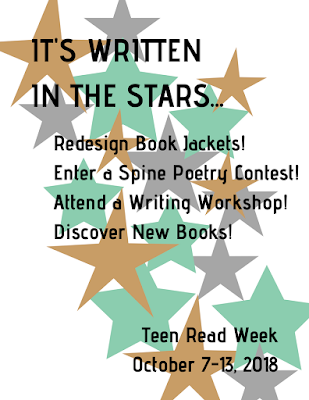
I used Canva for both a printable and digital flyer, though in reality, I'd stick with Canva just for digital use and/or if I needed a template. In the past, my design process has consisted of me sketching something out on paper, maybe printing out some text or graphics, then cutting and pasting the whole thing together. Obviously, this creates issues for repeating the process in the next month or year when a similar event happens (or if I am not around to recreate the promotional item), but if I am in charge of creative promotion, my talents lie in physical design - it's not that I'm digital design averse, I just have more skill in freehand design. The more I work digitally, the more intuitive these programs will feel, but I'll always enjoy creating with my hands.
Of course, I can (and do) start any digital work on paper, then do my best to translate it onto the screen, which is what I did here. I knew I wanted a starry background with text literally written "in"/onto it. I started with fewer stars, and put text inside, but that looked disorganized and was difficult to read/follow on the page. Instead, I made a path of stars across the page with the text over it, and I made an acrostic out of the main text. For the printable flyer, I kept the background white, with muted stars. The digital version has a black background, since I felt that would pop more onscreen.
I'd change a few things about this flyer in later versions (after more digital practice). Namely, I'd lean in to my acrostic more. I went back and forth on keeping it subtle, so you'd see it if you were looking, versus making those first letters larger/setting them apart in some way so it was obvious that "READ" is written in the stars, and after sitting with the design for a bit, now I wish I'd made it more obvious. I'd also play around more with the type - picking out fonts is both my least favorite and least exercised skill (again, since I prefer hand-lettering), but I'm sure I could create more contrast in the size or type.
What I truly appreciated about using Canva was the ease in which I could decide how to publish. I could download it as a PDF for printing, I could download it as a JPG or PNG for use online, and I could even embed the flyer straight to social media. Sharing a handcrafted flyer in all those ways would be difficult and look less professional, which means I'll be practicing lots more to bring my digital design skills up to speed!


Wednesday, July 25, 2018
Wiki to Sites Reflection
The closing of Wikispaces has put pressure on groups to move their online content elsewhere, this class being no different. Since I've worked with Google Sites in previous classes, creating my own resources for traveling on a budget and YA adaptations of "The Little Mermaid" by Hans Christian Andersen, I was happy to use it for a larger scale project.
Our first task, organizing the current wikis and their links, helped the project feel much more manageable. Once broken or outdated links were discarded and "like" topics were grouped together, there were much clearer parameters of the amount of information we were working with. The broader topics gave us more flexibility to group items, and since there are only six of us in the class, it was easy to divide and conquer.
Next came the testing of various curation tools, previewing how they might look live on the site, and working through what we wanted our final product to look like. We decided early on to use only a few curation tools, though we eventually landed on using just Pearltrees with a few modifications here and there. That made it easy to keep everyone on the same page and troubleshoot as we went along collecting our links, embedding into the site, and organizing collections.
The final organization of the page was a bit trickier to decide on, but after throwing around a few ideas - even broader categories, one mega page, random groups - matching each Pearltree collection to one of the class modules made the most sense. I learned a lot about how the embedding works on Google Sites, and how to group/ungroup items, which will be helpful in future uses of the platform.
Altogether, the process of creating a class site was simple - it helped that as a class we were willing to try things out, suggest ideas, and stay flexible - and the collaborative capabilities and intuitive controls of Google Sites ensured a quick transfer of class resources.
Our first task, organizing the current wikis and their links, helped the project feel much more manageable. Once broken or outdated links were discarded and "like" topics were grouped together, there were much clearer parameters of the amount of information we were working with. The broader topics gave us more flexibility to group items, and since there are only six of us in the class, it was easy to divide and conquer.
Next came the testing of various curation tools, previewing how they might look live on the site, and working through what we wanted our final product to look like. We decided early on to use only a few curation tools, though we eventually landed on using just Pearltrees with a few modifications here and there. That made it easy to keep everyone on the same page and troubleshoot as we went along collecting our links, embedding into the site, and organizing collections.
The final organization of the page was a bit trickier to decide on, but after throwing around a few ideas - even broader categories, one mega page, random groups - matching each Pearltree collection to one of the class modules made the most sense. I learned a lot about how the embedding works on Google Sites, and how to group/ungroup items, which will be helpful in future uses of the platform.
Altogether, the process of creating a class site was simple - it helped that as a class we were willing to try things out, suggest ideas, and stay flexible - and the collaborative capabilities and intuitive controls of Google Sites ensured a quick transfer of class resources.
Monday, July 16, 2018
Brochure Design Process
I learned several things in the process of creating an informational brochure for a fictional library. I went in thinking I knew exactly what I wanted to create, how I wanted it to look, and which design platform I would use. I quickly realized that the process of creation was going to take a bit longer than I thought, because it turns out design websites don't have direct access to my brain.
 After a few disappointing attempts using Lucidpress, I switched over to Canva. I'm sure I could've worked with Lucidpress (or any number of free design sites) and got what I needed from it eventually, but Canva felt more (that is, quickly) intuitive to my design process.

 After a few disappointing attempts using Lucidpress, I switched over to Canva. I'm sure I could've worked with Lucidpress (or any number of free design sites) and got what I needed from it eventually, but Canva felt more (that is, quickly) intuitive to my design process.
A word on my design process...it's most definitely not streamlined. I'm both a visual and hands-on learner, which basically amounts to me making multiple physical, but crappy, drafts of something before putting a final copy together. I like to see my design in action (plus I truly enjoy the art of crafting), which meant for this project I first had to create a few mini-mock-ups (tri-folding half sheets of paper) to work out which text sections would go where.

Another thing I learned/navigated was the tension between content and creation. Once I got going on Canva, I was ready to pick out fonts and colors and create striking contrasts...only I didn't quite have my content ready. I needed the images and text to carry on with the design, but the design was, admittedly, more "fun" to play around with.
Eventually I had a working brochure, and I can definitely see the use of this kind of product in a library. While I may be a Millennial, I still like to have paper copies of certain informational things, and I'm certainly not alone there. Libraries may or may not already have templates for brochures like the one I created, but either way, it's helpful to know I could jump in and update an existing brochure or create a new one (once I have all the necessary content and I've artsy-fartsy-ed my way through a few paper drafts, that is).
Wednesday, July 11, 2018
On Blogging
I'm taking two internet/technology classes this summer, one where I'm creating my own website and another more focused on using technology/apps as programming tools in a library. Both classes have me thinking about the future of this space. That I'll keep reviewing books and restaurants and movies and recapping my travels isn't the question, but I'm considering a platform switch, or a linked site that would house my blog along with my other internet-based creations.
Nine-ish years ago, when I first started writing here, Blogger was the easiest/quickest option for my needs. Since it's a Google product, I don't need a separate login, and I can import photos from my Drive super quickly (especially when I'm working from my Chromebook, which is sadly un-update-able and therefore not long for this world...but that discussion is for another post).
I might explore other blogging platforms or website options and decide this space is still the best (most convenient, simplest, does what I need it to do), but even then, I think it's due for some upgrades: cleaning up old links, refreshing the design, reorganizing a few of the pages. Stay tuned for new things in the future!
Nine-ish years ago, when I first started writing here, Blogger was the easiest/quickest option for my needs. Since it's a Google product, I don't need a separate login, and I can import photos from my Drive super quickly (especially when I'm working from my Chromebook, which is sadly un-update-able and therefore not long for this world...but that discussion is for another post).
I might explore other blogging platforms or website options and decide this space is still the best (most convenient, simplest, does what I need it to do), but even then, I think it's due for some upgrades: cleaning up old links, refreshing the design, reorganizing a few of the pages. Stay tuned for new things in the future!
Tuesday, May 23, 2017
Day 50
Woooooaaaah we're halfway there, wooaaah....that's all I've got to share. :)
I've written a page a day for 50 straight days, mostly. Once I completely forgot (around day 41) and made up for it with two pages the next day. Once I didn't forget, but I willfully didn't write (around day 43 - last week was rough, guys) and again, made up for it with two pages the next day.
All around, I'd say a pretty successful challenge. If I can do 50 days, I can do 50 more - and now that I've added grad school to my life juggle and things have settled down from the first few weeks of class, writing is finding its space in my daily routine again (instead of me wondering how I'm going to fit it in between practicing cataloging standards and writing discussion posts about library marketing).
What will I do when I reach 100 days? Unsure. I won't force myself to write full pages, but I do find that if I let my mind wander for a few lines I get out all the random schtuff in my brain and I can get on to the real schtuff. And there's something to be said about having a consistent routine. Stay tuned.
I've written a page a day for 50 straight days, mostly. Once I completely forgot (around day 41) and made up for it with two pages the next day. Once I didn't forget, but I willfully didn't write (around day 43 - last week was rough, guys) and again, made up for it with two pages the next day.
All around, I'd say a pretty successful challenge. If I can do 50 days, I can do 50 more - and now that I've added grad school to my life juggle and things have settled down from the first few weeks of class, writing is finding its space in my daily routine again (instead of me wondering how I'm going to fit it in between practicing cataloging standards and writing discussion posts about library marketing).
What will I do when I reach 100 days? Unsure. I won't force myself to write full pages, but I do find that if I let my mind wander for a few lines I get out all the random schtuff in my brain and I can get on to the real schtuff. And there's something to be said about having a consistent routine. Stay tuned.
Sunday, May 14, 2017
Thoughts on blogging & privacy
This blogger's post on introversion and connection is resonating with me today, but my online silence has less to do with being introverted and more with needing time to figure out what privacy means to me in a period of intense life change. Even coming here to share that fact feels exposing.
I have a few fun things I want to share in the coming weeks and months (so many thoughts on wedding planning and going back to school), but right now I'd rather spend my energies writing offline until I'm sure of what I want to say.
And I haven't forgotten about Photography Month:


I have a few fun things I want to share in the coming weeks and months (so many thoughts on wedding planning and going back to school), but right now I'd rather spend my energies writing offline until I'm sure of what I want to say.
And I haven't forgotten about Photography Month:


Tuesday, April 18, 2017
A Different Kind of Poetry
I hope no one needed me to remind them about Poetry Month this year - I decided not to write/post a poem each day here in lieu of something a little bit different. Instead, I'm participating in The 100 Day Project. It's a project that's usually art-driven, and meant to be shared (via Instagram, using #the100dayproject plus whatever other personal hashtag creators come up with), but I'm keeping mine mostly private. It won't end when Poetry Month does (or Photography Month), so it's not strictly poetic (or photographic).
If I had to make an original hashtag for my 100 days, it would be #100days100pages...or #100pages100changes. I started with everyone else (on April 4) and will continue to write one page in my journal each day for 100 days, ending mid-July. Those are my only rules. So far I've filled pages with all words, some words and lots of doodles, decorated quotes from role models, and bits and pieces from whatever day I'm documenting. It's not as artsy as some projects, and it's less focused on a beautiful product than others, but I knew when I started that I didn't want a lot of guidelines and I did want a detailed account of April-July 2017, a period of time that promises to be filled with so many changes.
Cheers to today, Day 15, and to 85 more days of writing, changing, and creating.
If I had to make an original hashtag for my 100 days, it would be #100days100pages...or #100pages100changes. I started with everyone else (on April 4) and will continue to write one page in my journal each day for 100 days, ending mid-July. Those are my only rules. So far I've filled pages with all words, some words and lots of doodles, decorated quotes from role models, and bits and pieces from whatever day I'm documenting. It's not as artsy as some projects, and it's less focused on a beautiful product than others, but I knew when I started that I didn't want a lot of guidelines and I did want a detailed account of April-July 2017, a period of time that promises to be filled with so many changes.
Cheers to today, Day 15, and to 85 more days of writing, changing, and creating.
Thursday, July 14, 2016
Searching for Everything
"...perhaps my life has not actually been so chaotic, after all. It is merely this world that is chaotic, bringing changes to us all that nobody could have anticipated." --Elizabeth Gilbert, Eat, Pray, Love

That craziness aside, I felt...okay. While I'm not happy that someone I look up to is going through an emotional time, I don't think I'm as sad (or mad or personally offended) as other readers of Eat, Pray, Love are. In fact, I can only hope that this is a positive and necessary change in Gilbert's life, one that couldn't have been easy, but will allow Gilbert to live her most genuine life. I guess for me, E,P,L was never about the relationship at the end. The adventure and message I got was to live wild and free, to make your own destiny, to seek both pleasure and divinity.
For these reasons, plus the fact that I didn't have a library book on deck when I finished my most recent read, I'm rereading E,P,L. It's my third time, but it'll be the first time the Love section might mean something to me. My first read, shortly before I studied abroad in Rome, focused on the Eat section and convinced me to go to Rome in the first place. I gave more attention to the Pray section in my second read, during my MercyWorks year, and it resonated with my own spiritual journey. At neither of those times was I in a physical or emotional space to think about Love, but now I am.
I'll read in the hopes of learning more about balancing pleasure and the divine, reminding myself why I chose the life experiences I did, and following all the ins and outs of my million gorgeous curiosities.
Tuesday, July 12, 2016
(Re)Orienting
I spent these past two days (plus last week) reorienting myself at work. Our headquarters is in a new space for the year, which means finding new work areas, adjusting to a different commute, and getting into a summer rhythm. We also welcomed three new Teaching Fellows with a few training overviews, a Q&A session, lunches, and (my favorite) an escape-the-room challenge.
It's been nice to take a step back from working in school to remind myself why I came to this program in the first place, and to introduce it to newcomers. I've enjoyed the change of pace and the more individualized work of summer projects to prepare for the fall. Personally, I get to edit and revise lesson plans and rubrics, all of which is right up my alley. (After a year of struggling to grasp what these educational materials are/mean, I am now well-versed in them and how to make them more user-friendly - especially for the non-teacher crowd.)
I didn't realize until I was in the middle of it, but I needed this shift in perspective and tasks. It's helped out my work life and my home life, since my purpose is more clear and I can truly relax when I'm off the clock, not wondering if what I did that day was enough.
This is my conscious reminder to take time to hit pause and refresh. To remember how I got to where I am. To keep on keeping on, in the direction of my wild and varied curiosities.
It's been nice to take a step back from working in school to remind myself why I came to this program in the first place, and to introduce it to newcomers. I've enjoyed the change of pace and the more individualized work of summer projects to prepare for the fall. Personally, I get to edit and revise lesson plans and rubrics, all of which is right up my alley. (After a year of struggling to grasp what these educational materials are/mean, I am now well-versed in them and how to make them more user-friendly - especially for the non-teacher crowd.)
I didn't realize until I was in the middle of it, but I needed this shift in perspective and tasks. It's helped out my work life and my home life, since my purpose is more clear and I can truly relax when I'm off the clock, not wondering if what I did that day was enough.
This is my conscious reminder to take time to hit pause and refresh. To remember how I got to where I am. To keep on keeping on, in the direction of my wild and varied curiosities.
Monday, January 11, 2016
5 Months in 121 Seconds
Late last July, I decided to try something new: I recorded one second of my day, (almost) every day. This app then combined all my seconds into a strange recap of the last five months of 2015. I'm doing this again in 2016, so by December I'll have twelve months' worth of seconds that will hopefully capture my year in some way.
I think this would be more meaningful if I could commit to a certain time of day to record - what if my video was all recorded between the hours of 7 and 9 am? Or what if I recorded the view from my window for the year? I'm toying with the idea of making several different month-long commitments to play around with things and see what seems best when I watch it all back.
[Note: while the watching is the best part, I'm having technical difficulties putting the actual video in this post. C'est la vie.]
Saturday, December 5, 2015
Nonsense: The Power of Not Knowing
 Nonsense: The Power of Not Knowing by Jamie Holmes
My rating: 4 of 5 stars
Sum it up in a sentence (or two): Jamie Holmes takes us on a tour of our own minds and shows us how we act when things are ambiguous, the ways we strive for closure, and the reasons why confusion might be beneficial to us.
First thoughts: I really enjoyed reading this book, especially right now in my life, when so many things are in transition and my own future is one giant question mark. I'm hoping I absorbed what I needed from it in this moment, thought I had to skim over a few jargon-heavy parts.
Favorite quotes (that will describe the book better than me talking about it will):
"Today's puzzle is to figure out what to do - in our jobs, relationships, and everyday lives - when we have no idea what to do." -p11
"Urgently fixating on certainty is our defense mechanism against the unknown and unstable. However, what we need in turbulent times is adaptability and calculated reevaluation." -p78
"...sometimes, the illusion of knowing is more dangerous than not knowing at all." -p128
"Under the right conditions...embracing uncertainty can in fact provide opportunities to innovate. It can inspire creative solutions, and might even help make us better people." -p154
"Ideally students should treat the feeling of uncertainty as an indication to keep thinking." -p170
Teacher thoughts: That last quote (and the section of the book it's from) really got me thinking about my kids and how uncomfortable they are with not knowing, or with vague answers. One of their math lessons was on estimation (ie, About how much is 578 + 912? Ans: 1500, more or less.) and I had the hardest time getting them to not use calculators - "The exact answer isn't what we are looking for! In fact, if you write the exact number down, that will be marked incorrect!" The skill the teacher was trying to build was estimation and educated guessing; we already know our students know how to put numbers into a calculator to get the right answer. English class is another area where ambiguity is sometimes the name of the game. Students are always asking me if their opinions are "right" and they hate it when I respond by asking if what they wrote is true for them, or if they can use words from the text to support what they want to say. They just want a yes or no. Sitting with confusion or with contradictory thoughts/feelings doesn't come easily to them (or to adults), and it's definitely a skill to learn and develop.
That being said: Bilingual students in general have an easier time being comfortable with contradictions and unknowns than monolingual students - it seems that holding two (or more) languages inside oneself helps in navigating between different sides of an argument or in expressing conflicting feelings.
Final thoughts: It seems like every day I am sure about fewer and fewer things, so Nonsense made a lot of sense. While I still want to seek out answers and find closure to events, thoughts, and feelings, I feel better about not knowing and about trusting the process of discovery.
Editor's Note: I received a copy of Nonsense from Blogging for Books in exchange for an honest review.
View all my reviews
Friday, July 10, 2015
Friday Night Links 23
My break week is over; I have one weekend left before I officially join the ranks as a Teaching Fellow for Citizen Schools. What am I mulling over these days? Things like this:
First, I'm glad I got to leave my job intentionally and take my time to say my goodbyes properly. I'm also grateful I worked in this break week. (I needed the time to clean and pack!)
Much like Elizabeth Gilbert, Laura Simms thinks Passion-Driven Careers aren't necessarily the goal. I'm glad I found a Purpose-Driven position.
I loved not hearing about "following your heart" - that sappy sentiment only leads to frustration as far as I've learned. It's working your ass off that pays the bills.
Speaking of paying the bills: "Do the best you can with what you have."
And another topical post from Austin Kleon, on learning in the open.
I'm so very excited to start this new chapter - once again, thanks to everyone who has cheered me on and joined me in all my adventures! The fun continues on Monday with the start of #teachingfellowlife (hashtag is a work in progress).
First, I'm glad I got to leave my job intentionally and take my time to say my goodbyes properly. I'm also grateful I worked in this break week. (I needed the time to clean and pack!)
Much like Elizabeth Gilbert, Laura Simms thinks Passion-Driven Careers aren't necessarily the goal. I'm glad I found a Purpose-Driven position.
I loved not hearing about "following your heart" - that sappy sentiment only leads to frustration as far as I've learned. It's working your ass off that pays the bills.
Speaking of paying the bills: "Do the best you can with what you have."
And another topical post from Austin Kleon, on learning in the open.
I'm so very excited to start this new chapter - once again, thanks to everyone who has cheered me on and joined me in all my adventures! The fun continues on Monday with the start of #teachingfellowlife (hashtag is a work in progress).
Subscribe to:
Posts (Atom)