Showing posts with label history. Show all posts

Saturday, December 9, 2017

Finding Their Way Home: A Review of Refugee by Alan Gratz

RefugeeRefugee by Alan Gratz
My rating: 4 of 5 stars

Told in three separate yet connected stories, Refugee is a historical novel of perseverance and commitment to one’s identity in the face of persecution. It will resonate with middle grade readers of today.

Josef flees from 1930s Nazi Germany and the threat of concentration camps with his parents and sister. He struggles with the responsibility of taking care of his family when he still feels like a child.

Isabel, her parents, and her neighbors use a makeshift raft to escape Cuba in 1994, during the unrest of Castro’s regime. Though never one to retreat from a challenge, Isabel worries for her pregnant mother during the dangerous journey.

Mahmoud, along with his parents and younger siblings, leave the violence of war in Syria in 2015, traveling through Europe as they search for a safer place to live. Unsure of the future of his country, Mahmoud wonders if his family will feel at home if they make it to Austria.

Though the details of their stories are unique, Josef, Isabel, and Mahmoud share more similarities than just their situations. Gratz gives attention to creating characters with heart and conviction, while the conflicts they face ensure none of their stories muddle in the emotions of the book as a whole. Refugee tells an important story without preaching or sensationalizing the experiences of refugees past and present. Maps and an author’s note highlight the reality of Josef, Isabel, and Mahmoud’s stories and show the readers how they can help with relief efforts.


View all my reviews

Saturday, November 11, 2017

What's Past is Present: Nine Historical Fiction Books for Kids & Adults

My Heart is on the Ground: the Diary of Nannie Little Rose, a Sioux Girl, Carlisle Indian School, Pennsylvania, 1880 (Dear America)My Heart is on the Ground: the Diary of Nannie Little Rose, a Sioux Girl, Carlisle Indian School, Pennsylvania, 1880 by Ann Rinaldi
My rating: 2 of 5 stars

I struggled with My Heart Is on the Ground, especially after reading the article about its inconsistencies. I remember reading almost all of the Dear America books growing up, so it’s possible that I read this one too, though I couldn’t tell you if it had any effect on me, or if I understood the extent of its inaccuracies. What drew me to this series as a child was the range of experiences of the various characters, and the diary format, which makes it more apparent that the book is fiction. While this story has aspects of reality - there were boarding schools meant for Native Americans in the late 1800s - there were far too many “artistic licenses” taken for anyone to recommend this book to children, at the very least without bold disclaimers.


My rating: 4 of 5 stars

Personal wars and victories set during an actual war highlight the variety of living situations during a time period, and The War that Saved My Life shares a powerful story of how World War II affected women and children in England particularly. The history of this book lives more in the background and edges, while Ada’s story takes center stage. This is a character novel that just so happens to be set in history. There are important historical details - the existence of child evacuees during WWII, blackout curtains and food rationing, a distrust of medical knowledge - but the growth of Ada as a character and the development of her and Jamie’s relationship with Susan are what this book is really about.


My rating: 3 of 5 stars

In The Madman of Piney Woods, the reader learns about generational similarities and differences between the children of Irish immigrants and enslaved people in Canada. The history of this book comes through on every page, in its characters and their conflicts. While I have no connection to either Benji or Red, I could still relate to the friendship of two seeming opposites, and to the power of shared experiences. Told in a he said/he said format, this book starts slow, but has a satisfying conclusion. Once Benji and Red meet, I enjoyed watching their friendship develop and anticipating how they would navigate their differences. An author’s note describes the motivation for telling this story, and lends credibility to the details.


My rating: 4 of 5 stars

Rita Williams-Garcia portrays the “why” of 1968 Oakland through the eyes of three sisters, and the eldest in particular in One Crazy Summer. In the context of a summer camp run by the Black Panthers, Delphine, Vonetta, and Fern explore their identities as black children in America, as sisters to each other, and as daughters to their poet mother. There was definitely research done to portray the girls accurately, as well as to include factual events and keep the style and tone reflective of the time period, Delphine’s background, and the setting of the story. Delphine, as our narrator, is matter-of-fact and quite descriptive of her own feelings as well as her interpretation of others’ feelings. I appreciated her no-nonsense style and could relate to her challenges of being an older sister while also recognizing her unique situation in history.


My rating: 4 of 5 stars

Told as a series of free verse poems, Brown Girl Dreaming is an autobiographical account of Jacqueline Woodson’s childhood and how she found her identity as a writer. Creative liberties and poetic style aside, this novel leans more towards personal history within the larger context of growing up in both South Carolina and Brooklyn in the 1960s and 70s. We see Woodson struggle with the feeling of not belonging anywhere in relation to her family’s struggles to adapt to different ways of life as political and social changes occur. There is a dreamlike quality to the poetry of this novel, and it was a joy to read about another writer’s journey to herself.


My rating: 3 of 5 stars

Jimmy McClean and his grandfather follow Crazy Horse’s path and we hear of his deeds as Jimmy learns to love who he is and what it means to be Lakota in In the Footsteps of Crazy Horse. Maps, a glossary, and a bibliography help to ground this story in fact, and this book felt more educational and historical than others we read. There is less dramatic character development, besides Jimmy eventually coming to terms with how he looks, and the fiction itself is set in present day, though it is geographically and politically accurate for the story.


My rating: 4 of 5 stars

I listened to the audiobook version of 90 Miles to Havana, read by the author, and appreciated hearing the names and dialogue straight from the source. The events that occur in Julian’s life are similar to Flores-Galbis’s experience of Operacion Pedro Pan, and are therefore credible and relatable. Themes of identity, family, and revolution weave in and out of the narrative and color each interaction. It was easy to feel the emotions of the story and to cheer for the characters.


My rating: 3 of 5 stars

Dead End in Norvelt is also an audiobook read by the author, inspired by his childhood. It’s historical in that the events of the story happened in the past, and are affected by the real life events of the time, but the story itself focuses more on the characters and the mystery of their fellow neighbors passing away at an accelerated rate. Some of Jack’s adventures remind me of stories my dad likes to tell of growing up in a small town, especially when he gets in trouble or is in some sort of danger and he shrugs it off.


My rating: 5 of 5 stars

It’s difficult for me to evaluate verse novels because they tend to be my favorite, but Inside Out & Back Again was both sad and hopeful, and remained true to both the poetic style and the historic settings of Saigon and Alabama. These poems are about acceptance, belonging, and identity, and share universal truths even in their specific details. While the details are about the fallout of the Vietnam War for one family, and Ha in particular, any reader who has felt out of place or not “something” enough to fit in will relate to this novel.


Monday, March 27, 2017

Chicago History Musuem

Why have I never been here before?! The Chicago History Museum is interactive, educational, and a fun time for this transplant and her native fiance.

Saturday, February 18, 2017

Reading is Respectful: Book Recommendations to Honor History

While I believe Black History should be taught and learned year round, this month we elevate and celebrate the accomplishments and achievements of black Americans - and that includes in our reading. The article I'm sharing lists seven books to start with, but these should be treated as just that - a starting point. From my own personal reading, I would add A Lesson Before Dying and Loving Day. (I'm not proud that I've read so few books by black women writers, especially recently. #readinggoals2017)

Again - even if history, coming of age, or historical sci-fi isn't your thing, black writers and black books come in all shapes and sizes and genres. Research the variety of authors that contribute to your preferred genres and try a novel or biography or romance or mystery or graphic novel by someone who you haven't read before, or someone who doesn't look like you. You just might find your new favorite author.

Wednesday, February 8, 2017

Let America Be America Again

A poem for Black History Month:

Let America Be America Again
Langston Hughes, 1935

Let America be America again.
Let it be the dream it used to be.
Let it be the pioneer on the plain
Seeking a home where he himself is free.

(America never was America to me.)

Let America be the dream the dreamers dreamed--
Let it be that great strong land of love
Where never kings connive nor tyrants scheme
That any man be crushed by one above.

(It never was America to me.)

O, let my land be a land where Liberty
Is crowned with no false patriotic wreath,
But opportunity is real, and life is free,
Equality is in the air we breathe.

(There's never been equality for me,
Nor freedom in this "homeland of the free.")

Say, who are you that mumbles in the dark?
And who are you that draws your veil across the stars?

I am the poor white, fooled and pushed apart,
I am the Negro bearing slavery's scars.
I am the red man driven from the land,
I am the immigrant clutching the hope I seek--
And finding the same old stupid plan
Of dog eat dog, of mighty crush the weak.

I am the young man, full of strength and hope,
Tangled in that ancient endless chain
Of profit, power, gain, of grab the land!
Of grab the gold! Of grab the ways of satisfying need!
Of work the men! Of take the pay!
Of owning everything for one's own greed!

I am the farmer, bondsman to the soil.
I am the worker sold to the machine.
I am the Negro, servant to you all.
I am the people, humble, hungry, mean--
Hungry yet today despite the dream.
Beaten yet today--O, Pioneers!
I am the man who never got ahead,
I am the poorest worker bartered through the years.

Yet I'm the one who dreamt our basic dream
In the Old World while still a serf of kings,
Who dreamt a dream so strong, so brave, so true,
That even yet its mighty daring sings
In every brick and stone, in every furrow turned
That's made America the land it has become.
O, I'm the man who sailed those early seas
In search of what I meant to be my home--
For I'm the one who left dark Ireland's shore,
And Poland's plain, and England's grassy lea,
And torn from Black Africa's strand I came
To build a "homeland of the free."

The free?

Who said the free? Not me?
Surely not me? The millions on relief today?
The millions shot down when we strike?
The millions who have nothing for our pay?
For all the dreams we've dreamed
And all the songs we've sung
And all the hoped we've held
And all the flags we've hung,
The millions who have nothing for our pay--
Except the dream that's almost dead today.

O, let America be America again--
The land that never has been yet--
And yet must be--the land where every man is free.
The land that's mine--the poor man's, Indian's, Negro's, ME--
Who made America,
Whose sweat and blood, whose faith and pain,
Whose hand at the foundry, whose plow in the rain,
Must bring back our mighty dream again.

Sure, call me any ugly name you choose--
The steel of freedom does not stain.
From those who live like leeches on the people's lives,
We must take back our land again,
America!

O, yes,
I say it plain,
America never was America to me
And yet I swear this oath--
America will be!

Out of the rack and ruin of our gangster death,
The rape and rot of graft, and stealth, and lies,
We, the people, must redeem
The land, the mines, the plants, the rivers.
The mountains and the endless plain--
All, all the stretch of these great green states--
And make America again!

Monday, June 13, 2016

Professional Chaperoning

As a teaching fellow, my job description is flexible. Some weeks it includes classroom assistant, copy girl, and volunteer coordinator, but last week I was one thing: a professional chaperone. My team joined our school's 8th graders (well, the 60 who didn't go on the Washington, D.C. trip) on daily field trips in the Chicagoland area. We visited a few places I'm familiar with and a couple of new-to-me locations, so while I'm glad I won't be riding a yellow school bus for at least a few more months, I'm also grateful I got a (sort of) work-cation. Here's a quick recap:

Monday: Illinois Holocaust Museum & Education Center
Easily the most "school-like" trip we took. Our tour guides had the students break off into groups to "research" certain areas of a larger 1936 Olympics-themed exhibit. (So interesting - did you know the tradition of the torch relay started in Berlin, thanks to Adolf Hitler?) Then we all met together while each group "taught" the exhibit assigned to them.

I can't give an accurate portrayal of the museum itself, since I was too busy herding middle schoolers (and, honestly, trying to remember the names of the 10 I was responsible for - I don't ever work with the 8th grade), but I can say the tour guides are dedicated and the collections are extensive - as the guides repeatedly told the students, "Everything in this museum is real." This trip was both educational and sobering.

Tuesday: Cantigny Park
This trip was my favorite - I've never been to this city getaway turned public park and museum, and it was the perfect mix of structure and free time for the kids. We got tours at the First Division Museum (an immersive/interactive history lesson from the POV of the 1st Infantry Division) and the Robert McCormick Museum (a guided walk through McCormick's sprawling mansion), plus time to explore Tank Park (11 tanks from WWI through Desert Storm - and yes, they're okay to climb on. They survived war, I think they can handle a bunch of 13-yr olds.)

I'm really hoping I can visit Cantigny again, hopefully with friends/family instead of teenagers. For the price of parking, you get admission to both museums plus all the gardens/grounds. This would make a great day trip!

Wednesday: Museum of Science and Industry
I've been here before, so all I'll add is this: it is impossible to keep 10 students in one area when there are tornadoes to walk through, submarines to walk around, and most importantly a giant mirror maze to get lost in. (Note: Never send children back into the maze to retrieve lost wanderers. They will just get more lost together.)

Thursday: Northwestern University and Bahá’í Temple
On this day, the students received tours at Northwestern (from former students) and at the only Bahá'í House of Worship in North America (from a current member of the Bahá'í faith). It was a day for getting out of comfort zones and imagining life outside of their middle school bubble - we challenged the students to think about where and what they would like to study after high school and to view the world through someone else's perspective. Although not all of the students were ready for the maturity that higher education and religious discussions require, a good number of them rose to these challenges, asking relevant questions and sharing honestly about their beliefs.

Friday: Logan Square Scavenger Hunt and Koz Park Games
We kept it local on Friday, touring the neighborhood and taking photos at pre-determined locations, then meeting up at a nearby park to compete in a few relays and field day activities. This was our most relaxed day, and a great way to end the week in a semi-celebration of all our time together.

All-in-all, I enjoyed meeting a few new students (even if they graduate next week) and it was refreshing to be out of the classroom! I recommend extended chaperoning to anyone with some spare time, a joy of sharing experiences with students, and lots of energy.

Saturday, March 12, 2016

In a Different Key: The Story of Autism

In a Different Key: The Story of AutismIn a Different Key: The Story of Autism by John Donvan
My rating: 4 of 5 stars

Sum it up in a sentence (or two): A history of autism, told as a story with major characters, both heroic and antagonistic. The most inclusive/comprehensive piece of writing I've ever read on the topic.

First thoughts: As someone who isn't super familiar with autism, this was a fascinating read. It really is a story - a collection of stories - that altogether shows the big picture (maybe not the entire picture, but a lot of it) of something humans have struggled to categorize for close to 80 years.

Story thoughts: I'm really emphasizing this. This book was a story. Non-fiction, yes, but even down to the terms the authors used - "narrative of autism," "cameo appearances," "observations," "interpretations," - and how each person is introduced as a character with unique motivations and developments. And the cliffhangers! There was a lot of drama, things I didn't expect, things that kept me hooked. There were twists and turns and red herrings, almost like a historical mystery.

Favorite quotes:

"...the definition of autism has always been malleable." -p370

"If you've met one person with autism, you've met one person with autism." -p371

Recommended for: anyone who works with, knows, cares about, is confused by, or has wondered about someone with autism, med school students of all specialties, teachers of all age ranges, historians, and social workers.

Final thoughts: Whew. Intense - but I feel a lot more educated (and like I should read further) on the topic of autism. It has a dramatic story - ups, downs, different "champions," different perspectives. This was both interesting and informative.

Editor's Note: I received this book from Blogging for Books in exchange for an honest review.


View all my reviews

Friday, November 13, 2015

As the Philadelphians Do

This past weekend I attended my final wedding until 2016, and the 5th wedding of my 13 MercyWorks roommates. (Numbers 6 and 7 are next year, and are also coincidentally the same wedding!) It was in Philly, which means I flew to the East Coast three times this year (Boston, Baltimore, Philadelphia). This time I took a few days off work and made a vacation out of it with Jesus and several other MercyWorkers.

While I didn't eat a cheesesteak, I had plenty of other great food (not to mention drinks!) to make the weekend memorable. By chance, I reenacted several scenes of National Treasure (and by plan, one very important scene of Rocky). I did it all with my person, Jesus, and we marked our 4th anniversary with a romantic breakfast date at Jamba Juice in the airport before I napped pre- and during flight.

Travel Recommendations:

Do:
Liberty Bell / Independence Hall - One of Philadelphia's most well known landmarks/historical sites. Both are free, though Independence Hall does require tickets for the guided tour.

Reading Terminal Market - Part food court, part indoor farmer's market, part dream store for all event coordinators. Featured in one of National Treasure's chase scenes, RTM is a humming hub of happenings close to Center City. Go for lunch, stay for people watching!

Mütter Museum - There's a wall of skulls. Need I say more? This museum is perfect for those with morbid curiosities, American Horror Story fans, aspiring doctors, and anyone with curious imaginations.

Map of Philadelphia, with major roadways as neurons
Rodin's Thinker - If we had had more time, we planned on visiting the Rodin Museum to see the largest collection of Auguste Rodin's sculpture outside of Paris. Instead, we stopped by The Thinker outside, took a stroll around the garden pool, and gazed on The Gates of Hell.

"Rocky Steps" - We didn't go to the museum attached (Philadelphia Museum of Art), nor did we run all the up, but we did take our picture by the statue and climb to the top of Rocky's iconic steps for its sweeping view of Philadelphia.

Eat/Drink:
Tria Taproom - We happened to meet the owner of this trio of bars, and on his recommendation stopped by the Taproom (not a bottle to be found - even the wine is on tap!) for a few drinks and appetizers before dinner one night. It was classy, yet comfortable. And the cheese curds were satisfying, even to this Wisconsin girl!

Irish Pub - Yes, it's really called that. We hung around here for the extended happy hour, and chatted with our bartender (who was also attending a wedding that weekend). She gave us the rundown of the neighborhood, and where to go the next time we're in town.

Dinic's @ Reading Terminal - After this roast pork sandwich, I didn't even want a Philly cheesesteak. Dinic's doesn't offer all the extras, just roasted meat, a few choice toppings, and a sandwich to hold you over until a late dinner.

La Colombe - Tasty, no-nonsense coffee. Not native to Philly, but a great addition to our morning routine!

Stay:
Dom's Loft in Rittenhouse Square - Perhaps the defining aspect of the trip was our lodging, a truly quaint Airbnb in the Rittenhouse Square neighborhood. This loft, a renovated dining room of a large mansion, was all things Philadelphia: historic, artistic, classic, and a little gritty. We loved the intricate details of the woodwork, the wrought iron spiral staircase, and the literally "off the path" entryway.

Wednesday, December 10, 2014

A Journal Journey Pt 2

Another journal milestone: I finished this little guy (finally) after just over a year of scribbles. My journaling was slow this year, something I hope to remedy in 2015. I love blogging and writing on here, for an audience, but journaling is my true release and creative outlet/muse. It only took me until about now to realize that I have a hard time writing creatively before I write out all the junk first. So, less journaling means less creative writing, which means a less fulfilled human. Anyways, I know that now, so here's to fulfillment in 2015!

And here's my journal journey to date: everything personal and cringe-worthy from my life in 12 notebooks.
It's strange that I know most of their contents by their covers. The black one is my Rome journal, one of my favorites for obvious reasons. I taped/stapled nearly every receipt, ticket stub, train pass, brochure, and whatever other scraps of paper I came into contact with while abroad inside (that's why it won't close) and I'm so glad I did. That's something I forget to do now, but hope to make a habit again. Those scraps trigger memories and inspire stories. The one with the circles and the white one with the hair tie around it are from MercyWorks. There's a lot of growth in those (so much I needed hair ties to keep them secured). Large portions of all of these journals feature my favorite lines from songs and books, silly to-do lists, and self-pep talks. Sometimes I recalled a day's events, but more often than not I just recorded the moment's feelings, anxieties, prayers, goals, and hesitations.

Up next, filling this guy with whatever inspires me.

Tuesday, November 4, 2014

Election Day 2014

Did you vote today? Remember, you can't complain about politics if you haven't done your share! Voting is super easy here--in Chicago we were able to vote early until Saturday at one of 50 locations, including libraries. And you can register and vote all in one shot. So easy! (Yes, I say this knowing that hundreds of "provisional" voters are stillllll waiting in line.)

I had no line at 10 in the morning and luckily, my polling place is only a few blocks away. I made the walk before work, did my civic duty and then my gainful employment duties, and I'm now watching election coverage. If you don't know much about Chicago/Illinois, you probably know that corruption is the name of the game around here, so I always find even these midterm elections pretty interesting. After all the mudslinging we've had to deal with, I like watching and seeing who came out on top. (Again, I say this knowing we might not know who wins the gubernatorial race until mid-November!)
On another, semi-related note: did you change the batteries in your fire/carbon monoxide alarms this weekend? Ideally you're testing the alarms monthly, so you know ASAP when batteries are running low, but a yearly switch out can't hurt. (We can file this little tidbit under Stuff House Managers Deal With.)

Thursday, September 11, 2014

Half My Life

Most days aren't that different from the day before--any changes are gradual--but today felt different. Definitely cooler. Grayer. A distinct shift from what yesterday and the past few months have offered. A good day for meditation and remembrance.

September 11, 2001 seems like a lifetime ago. For some people it is. For me, it's half a lifetime ago. I was in eighth grade at St. Mary's, but that morning I was at the high school for band class. We always turned the TV on when class was over and while we waited for our ride back to St. Mary's, so I wasn't really paying attention to what was happening. But then I was.

From now on, more of my existence will be post-9/11 than pre. And yet, I'm still surprised when a book I'm reading mentions September 11th, or when it in some way influences the plot. It seems so fresh still. I do the same thing every time--flip to the front pages to check the publication date. 2003. 2008. 2011. Last year. How long until September 11th feels like history instead of current events?

I know that's a loaded question, so I won't even attempt an answer. Instead, an excerpt from this letter written by Frank Culbertson, the only American not on Earth on September 11th:

"I know that we are on the threshold (or beyond) of a terrible shift in the history of the world. Many things will never be the same again after September 11, 2001. Not just for the thousands and thousands of people directly affected by these horrendous acts of terrorism, but probably for all of us....It's horrible to see smoke pouring from wounds in your own country from such a fantastic vantage point. The dichotomy of being on a spacecraft dedicated to improving life on the earth and watching life being destroyed by such willful, terrible acts is jolting to the psyche, no matter who you are."


Monday, September 2, 2013

Bristol Renaissance Fair

Labor Day has come and gone, and with it goes summer. I ended mine with a trip back to 1599, at the Renaissance Fair in Kenosha, WI. I've never been to a Renaissance Fair before, but my friend Becca warned me that there would be plenty of cleavage among all the characters who come out and dress up in traditional attire. There was also lots of facial hair, fairy wings, pet dragons, and swords.

Jesus and I dressed only for comfort, not for the time period, though Jesus did add some mustache wax to ensure plenty of compliments and 'stache comparisons. He also got picked to hold the end of a rope with several other men so that a performer could balance on it and juggle. I did not get picked for anything, but I did get a free hand massage to try out some candle lotion.

We saw men sword fight, a blacksmith demonstration, a glass-blowing demonstration, feats of strength and balance, magicians, jousting, falcons, and a man spewing insults as people pelted him with tomatoes. We ate modern food - calzones, nachos, roast beef, pizza - but there were also turkey legs, soup and bread, and beer in big mugs.

I'm glad I got to end the summer with a "Huzzah" ...but I'm looking forward to stretching out "summer" well into September, possibly October. When you're not in school anymore, summer is anytime the weather is nice.

Wednesday, September 7, 2011

Eternal City, Second City

Remember how obsessed I was with ancient Roman history when I studied abroad? (Refresh your memory in my archived posts.) Brit is probably just as obsessed with Chicago history and has quickly turned me on to it. She's got me reading books like Sin in the Second City by Karen Abbott and it's uncanny how similar the cities actually are.

Chicago is notorious for its crime and corruption, and much like Rome it has many mob connections. Both cities have rich traditions of underworlds, secret groups, and dark sides exploited in books and movies. In Rome, "que bordello!" is uttered to comment on something being wild (literally, a whorehouse). Chicago was home to one of the most illustrious bordellos in America at one point.

The Eternal City and the Second City of course share less corrupt things in common as well: an intense passion for food, varied and diverse neighborhoods, sports rivalries (Lazio v Roma soccer/Cubs v White Sox baseball), and funky street smells (hot garbage, piss, dog) for example.

My apartment reminds me of living in Rome as well. I stand on my front porch and watch traffic on my one-way street, I hear many conversations from the building next to me through my window, my downstairs neighbors are always smoking, and I'm only a little way from the train into or out of the city. My neighborhood is residential and has an old working-class feel. It makes me want to write a lot.

The biggest difference between my two lives is most likely having fairly efficient public transportation and streets on the grid. It's far less difficult to get lost or be late here. Sad day.

Thursday, March 31, 2011

White Walls/All of the Lights

It's a strange, almost eerie feeling to visit the near ruins of a housing project high rise at dusk. Fans still spin in the very topmost apartments. A satellite TV dish hangs from one window. Graffiti screams "I NEED MONEY" from one of the interior walls made visible after the first day of demolition. LED Lights in each apartment blink off and on, almost like a laser light show.

Yes, LED lights. The last standing high rise of the infamous Cabrini-Green housing project has been reclaimed as art for its last weeks standing. These lights will continue blinking from dusk to dawn until demolition is complete, one fading each time an apartment is lost to the wrecking ball. Actually standing there, right on Halsted, the effect  made the building seem alive. Visit projectcabrinigreen.org to see the continuation of the art, an interactive piece where one can listen to poems and stories of actual Cabrini-Green residents. The blinking lights are actually set to the vibration of their voices reading their stories.


My community visited this site last night after our Community Night featuring Brad Hunt, a professor at Roosevelt University and author of Blueprint for Disaster: The Unraveling of Chicago Public Housing. He explained to us a short history of public housing in Chicago, how it was meant to clear slums but as a result of many factors (racism, ineffective policy, site location, design, youth density) became a black mark for the Chicago Housing Authority, one that they are currently attempting to erase by demolishing practically every high rise ever built in the city, regardless of the need to do this.

This event is relevant for us MercyWorkers not only because we are living in Chicago, and the housing projects are very much connected to Chicago's past, present and future, but also because of the population we work with. I personally have one youth in program who used to live in Cabrini-Green, but now lives in the new mixed income housing only blocks from the current demolition site. To some the closing and tearing down of Cabrini-Green is just the razing of some super ugly buildings, getting rid of the places where a lot of shitty things happened, but to him this is the destruction of home, of his community, the place where generations of his family grew up.


There is a lot of debate and emotion at play with the whole public housing situation, but regardless of where people stand and what they think of it all, everyone recognizes this as an end of something, and most, accepting that this is happening, only want to make sure it is remembered and documented for future Chicagoans. Hence this light show art installment, plus many other documentaries, class projects, photo journals, newspaper articles, and perhaps the most important thing to come of this, the National Public Housing Museum. Still in its infancy, the museum hopes to preserve the entire history of public housing--the good and the bad--for the entire nation. I hope I'm still in the city once it opens in its new location, only several blocks from my apartment.

Until then, I'll be reading up on my history. (Chicago ain't no Rome, but it'll do.)

Monday, March 7, 2011

Happy Casimir Pulaski Day!

Who is Casimir Pulaski, you say? Good question.

He's a Polish guy who fought in the Revolutionary War as a cavalry man. He's known as "the father of American cavalry," I think mostly because he saved George Washington's life. In 2009, he was granted honorary American citizenship, which I guess is cool except he'd already been dead 230 years.

There isn't much else to say about the man, besides he loves freedom. And yet all Chicago Public Schools are closed today, as are Chicago Public Libraries and a plethora of other city and county offices. In honor of Casimir Pulaski Day. The Polish population here has pretty big pull.

Tuesday, April 6, 2010

domani è già qui [tomorrow is already here]

Today is the one year anniversary of the L'Aquila Earthquake. Since then, I've been a lot more aware of earthquakes around the world. Either that, or there have just been a lot more than ever before. Here is one blogger's memory/reflection of the quake.

And according to this article, there will be plenty more memorials and remembrances as well as debate about reconstruction after the quake. If this earthquake, occurring in a developed country, still affects so many people, can you imagine how long it will take to put Haiti back together? It's overwhelming.

Like all the charity work and celebrity attention Haiti has, there was also a group (Artists for Abruzzo) who wrote a song to help the residents of the Abruzzo region. I love it musically--all my favorite Italian artists in one song! And the lyrics are solid as well. This version translates the lyrics, and while they are a little confusing at times (some things don't translate all that well), it does give you the same message--we're not alone, tomorrow comes to everyone.

Monday, April 6, 2009

Happy Birthday Raphael!

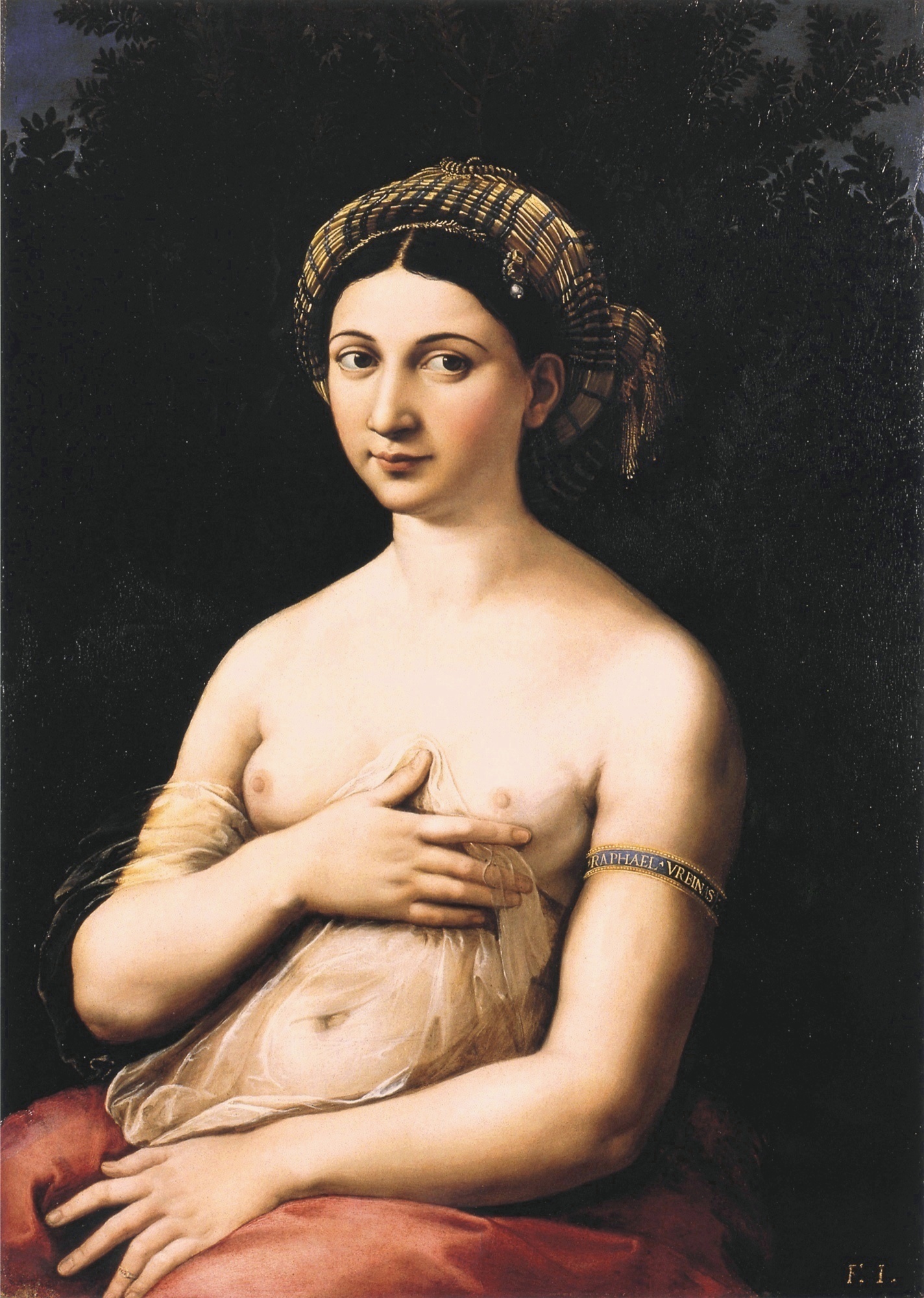
Today marks another important date in Italian/Roman history as both the birth and death date of the painter Raphael. When I researched Raphael to see what works of his I could find in Rome, I was pleased to see I have already seen most of them.

One of the first things I saw in Rome, the Pantheon, houses the tomb of Raphael, who died in Rome in 1520.

The Villa Borghese houses a few portraits and the Palazzo Barberini houses "La Fornarina" (the bakers daughter), a portrait of Raphael's lover and a model for many of his portraits. Raphael was also the one to suggest the "Latin Cross" design for St. Peter's.

Still on my list of things to do in Rome is see the Vatican Museum, where one can walk through the Raphael Rooms and admire other paintings by Raphael. He also painted the frescoes in the Villa Farnesina.

It's just the beginning of an eventful week in Rome: yesterday was the start of Holy Week with Palm Sunday and the Pope's blessing in St. Peter's Square and today saw the biggest earthquake to hit Italy since 2002 plus the anniversary of Raphael's death and birth. Passover begins at sundown on Wednesday and continues on Thurdsday--and even though Rome is traditionally seen as Roman Catholic, there is an area called the Jewish ghetto and Jews are actually quite numerous in Rome. Holy Week festivities continue Thursday through Sunday, beginning with the Mass of the Chrism Thursday morning then the Mass of the Lord's Supper in the evening and going until the final event, mass on Easter Sunday.

It's all enough to keep me busy! Not to mention now I have to work my way through crowds of tourists just to get to school--and they will only become more and more numerous as the weather gets better and we find ourselves in the midst of high season.

Tuesday, March 10, 2009

Just Living in Rome

What did I learn on Monday?

The Italian word for "envelope" is the same as their words for paper or plastic bag. I needed to buy envelopes and went to a store that sold them, according to their website, but I was told by the lady that they sold bags. I looked around the store and sure enough, it was filled paper bags of all different sizes. I'm not sure what the market is like for paper bags...

Luckily, she knew of another store that sold the kind of "envelope" I was looking for just around the corner. And when I asked for directions in Italian, I understood the answer!

On my way home from mailing my letters, Marina called me to join her in the botanical garden near John Cabot. I'm glad she called, too, because it was such a beautiful day and we saw not only the gorgeous plants but an uninterrupted view of Rome from a lookout as well.

It's always breathtaking when we find these lookouts, no matter how many times we see them. The first few times it was breathtaking because it was new and foreign--a great big city that we were supposed to somehow figure out how to live in. And now, since we have (sort of) figured out how to live here, when we see it, it's like seeing our home away from home. Now we can pick out certain spots (the church at the top of the Spanish Steps, Villa Borghese, the Victor Emmanuel II Monument) all from our lookout in Trastevere. It's breathtaking to know just where you are and where you have been: Rome is huge and yet we've walked all around it.

I guess it's about time we started feeling at home here. We're halfway through the semester and these next nine weeks are going to fly by!

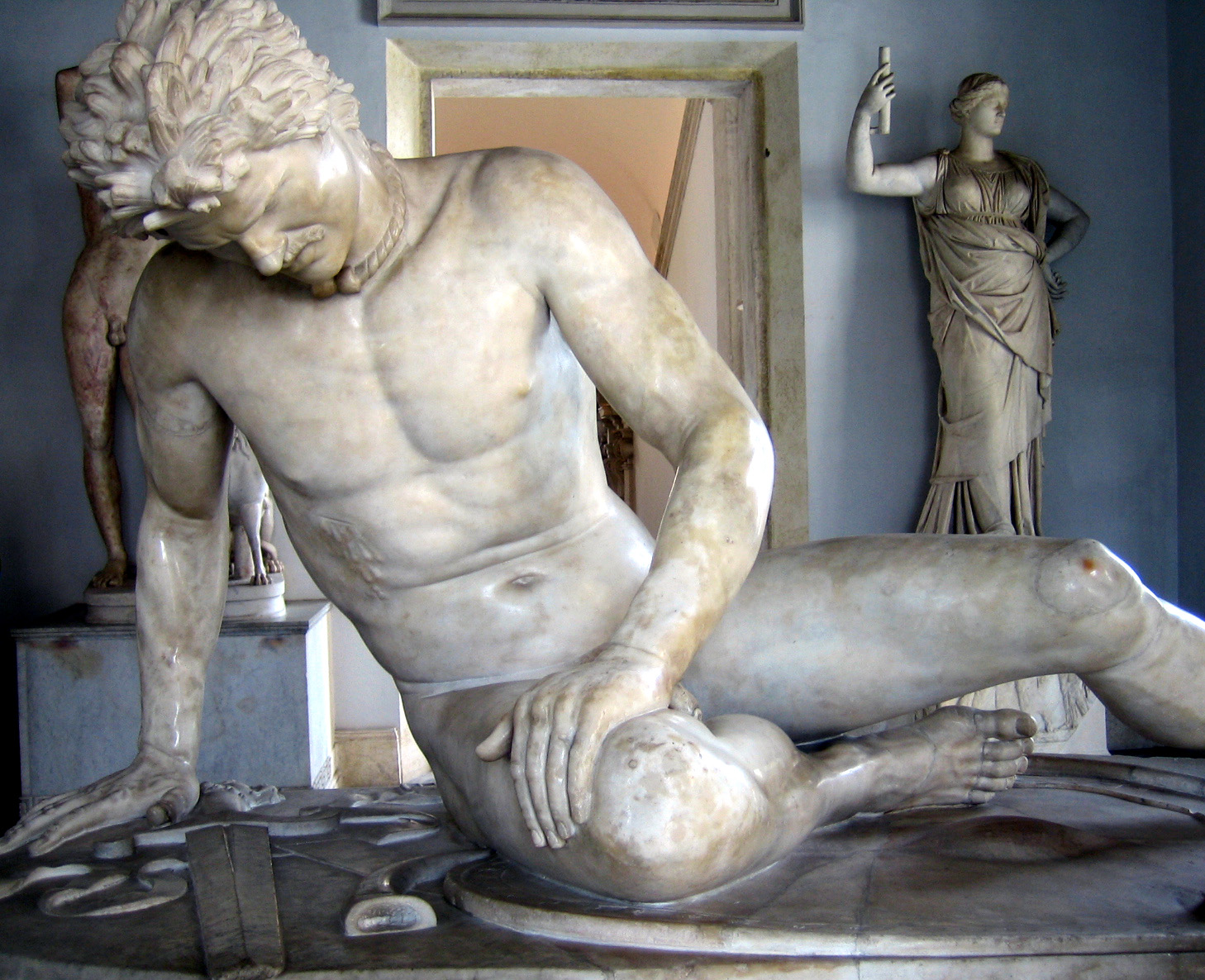
Today in my art history class we visited the Capitoline Museum. It was nice since we've been running all around the city of Rome to finally stay in one place and see so many amazing things. We got to see the original bronze statue of Marcus Aurelius (the copy is in the center of the square) and a few other bronze statues. Only a few because the rest were melted down during a time when bronze was more important than the art.

We also saw the remains of the Colossus of Constantine--the head, right hand, feet, a leg, a kneecap and an elbow. Even with only those parts you can imagine just how huge the statue must have been. And of course we had to see the bronze she-wolf nursing the (added later) twin babies (Romulus and Remus).

My favorite one was the Dying Gaul though. I think because it's not just a statue of an emperor or someone posing for a portrait, it's telling a story and there is a lot of emotion in the statue.

The common theme, though, was that historians are for the most part unsure where most of these statues were originally located in Rome. They have been moved around, reconstructed, lost, found and who knows what else. It gets kind of confusing in class when my professor says "Well, it's here now, but it was in the Campus Martius we think" or "And those statues were originally in the temple dedicated to Castor and Pollux but not the one we learned about in the Forum, another one near the Tiber..." There are so many things to remember!

In other news, I got an A on my Italian midterm. Apparently I understand it better than I thought! I haven't gotten my stats midterm back yet, though; that I'll get tonight...and that's the one I'm nervous about. That and this social research methods one due tomorrow. That deserves its own blog, really. It only has four questions but they can get pretty intense. Especially since it's meant for political science majors in their senior year, preparing for their theses and I am just about the furthest thing from that.

I'll get it done, though. He said we could do outside research for it, since it is a take-home, something I've had to do since I don't know enough about the crisis in Darfur or the economic situation in China to talk endlessly about them (like my professor can...it makes my head swim sometimes).

But enough about that, I've got to catch the tram for stats class. If I passed my midterm I'll let you know!

Friday, March 6, 2009

Happy Birthday Michelangelo!

Today is Michelangelo's birthday; he was born in 1475 in the Tuscany region. His works are found all over the world, but at the age of 21 he came to Rome and that is where some of his most famous pieces/architecture resides. So what did I do to celebrate this occasion? After a breakfast of banana pancakes, I headed into the city to check out some of the pieces Michelangelo is known for in Rome.

I've seen St. Peter's Basilica already, (and La Pieta inside) but that is perhaps the most famous of Michelangelo's architecture, especially the cupola. I've also been to Palazzo Farnese, home of the French embassy, and the Capitoline Hill (though that one I visited again--it was on my way during my wanderings this morning).

My first stop was Santa Maria sopra Minerva, located just behind the Pantheon. From the outside it doesn't look like much, but don't let that fool you. Santa Maria is gorgeous inside, with high ceilings painted a deep blue and marble everywhere. Numerous side altars lead up to the high altar and to the left there is a statue of Christ Carrying the Cross. It's also known as Christ the Redeemer or Christo della Minerva and was carved by Michelangelo in 1521. The figure was originally nude, but during the Baroque period a covering was added. The first thing I noticed was how calm and ready Christ looked, even though he is holding the things that will kill him. The statue is supposed to show his willingness to die for us.

After a few extra minutes walking around the church in awe of its greatness, I started for my next stop: Basilica dei Santi Apostoli. None of Michelangelo's works are found here, but this is the church that housed his tomb for a while before it was moved to Santa Croce. Anyways, it was worth going to if only to see the fresco above the sanctuary, the Fall of Lucifer and Rebel Angels. It's an illusionist painting so it looks like the angels are falling out of the painting, out of the ceiling, and into the church.

Next I made my way through the Piazza del Campidoglio, designed by Michelangelo between 1536-1546. Instead of having the square face the Roman Forum, Michelangelo turned it around to face Papal Rome and the stairs leading up to it are meant to show the link between the new and old Rome. Because of the odd shape of the square, Michelangelo had to be creative in order to make it feel as though the buildings were symmetrical and that a person standing in the square felt like they were on top of the world. It's actually egg-shaped and the slope is off, but of course Michelangelo pulled it off.

After a quick walk past the Roman gladiator who always asks for a photo outside the Forum and up Via Cavour, I found myself at my last stop of the day, San Pietro in Vincoli (St. Peter in Chains). This church houses the relic of the chains said to have bound St. Peter when he was imprisoned in Jerusalem. They keep these chains in a shrine under the altar. When I was at this church, so were a few Italian school tours, so I had to weave through them to get pictures of the reason most of us were there: Michelangelo's statue of Moses. The statue is flanked by slightly smaller statues of Leah and Rachel. The entire work was supposed to be much larger and was for the tomb of Pope Julius II but the pope interrupted Michelangelo's work for unknown reasons and it was gradually scaled down to what we see today. It is still quite impressive, with Moses looking fierce holding the tablets with the commandments, his beard down to his chest and horns on his head. (The horns have something to do with the biblical story--Moses having rays of light coming from his face. I guess the horns were meant to show that, and were easier to carve than a ray of light would be.)

The trees on our street are starting to bud and the weather has been gorgeous (besides the lingering rain)...hopefully spring comes to Wisconsin soon as well!

Thursday, March 5, 2009

Colosseum

Alright, I should be studying for the Italian midterm I have in 2.5 hours (or the Stats midterm I have later tonight) but here's a quick note updating you on my art history course this Tuesday.

We started out by the Colosseum's metro stop and from there went up the Palatine to see the Flavian Palace (it's not so much a palace as the ruins of a palace these days). Then we came back down and got to go inside the Flavian Amphitheater...better known as the Colosseum.

I knew we would be going inside sometime during the class, so that's why I haven't gone in on my own. We had to be kind of sneaky since they don't really let unofficial tour groups inside (tour groups including classes like ours) so our teacher hung out at the back of the line as we walked through nonchalantly until we got all the way in. I guess they do it to guard against phony tour guides.

Of course I knew from the outside that it was huge, but you can't really appreciate it until you are inside. I posted my photos already (they are at the end of the album) and those give you some sort of idea of what it's like. I sometimes feel silly because I am usually the only person taking photos during class, but I paid for the class, I might as well take the photos. I don't know if the other students just don't care or if they have already been to these places and taken pictures. It's kind of funny because I'll usually stay behind at a site to get another photo and then I'll have to rush to catch up to the class. I'm sure they make fun of me. (I'll let them...it's their loss, right?)

That was my excitement for the week, seeing as after that I had 4 midterms to prepare for. One is done, two I have today, and another is a take home due next Wednesday. And speaking of midterms I'm going to get back to the studying!!